

This committee should determine the final railway transportation tariff through a comprehensive approach, including: assessment of the actual infrastructure costs, analysis of market conditions and competition with road transport, consideration of customer price elasticity, and preservation of incentives for private sector investment. The committee should also utilize the capacities provided under Article 6 of the law.
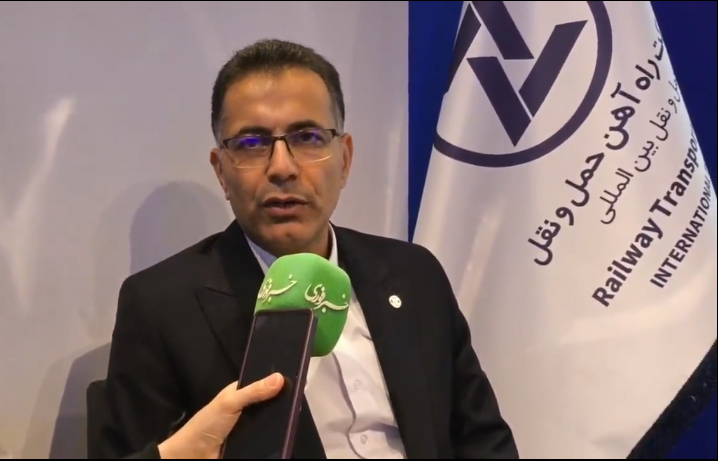
According to the Public Relations Office of RWT, citing Tin News, Hassan Sedighi, CEO of RWT and Board Member of the Association of Rail Transport Companies, explained the factors behind the growth of rail transit in the past year and discussed existing threats and corrective solutions.
Last year was an unusual year for Iran’s rail transport sector. On one hand, the sharp decline in sulfur transportation during the second half of the year — traditionally one of the main rail transit commodities — created a major shock for the network. On the other hand, regional geopolitical developments increased the risks associated with cargo transit through Iran. Nevertheless, statistics indicate growth in rail transit tonnage; growth that appears promising at first glance, but raises deeper questions regarding sustainability, tariff structures, and the balance of interests between the private sector and the government.
What is your assessment of rail transit growth this year? Can this growth be considered sustainable?
To provide an accurate analysis, rail transit growth should be evaluated through two separate indicators: transported tonnage and ton-kilometers. Although related, these indicators convey different messages.
In terms of tonnage, fortunately we have witnessed growth. This occurred despite serious geopolitical risks over recent months, risks that could naturally have led to a significant decline in cargo transit through Iran. Therefore, from a quantitative perspective, acceptable performance has been achieved.
More importantly, this growth occurred while we almost lost one of our most important transit commodities — sulfur — during the second half of the year. Traditionally, sulfur accounted for 60–70 percent of the country’s rail transit volume. Such a sharp reduction would normally have caused a major decline. The fact that this reduction was largely compensated demonstrates the ability of railway companies and the rail network to adapt to new conditions.
How did this adaptation occur? Which commodities or routes replaced sulfur?
Replacement occurred through several key corridors. First was the Afghanistan route. During the first ten months of the current year, more than 600,000 tons of international cargo were transported to Afghanistan, including both exports and transit cargo. This figure is significant compared to previous years.
Second was the increase in exports to CIS countries via the Motahari station. Part of this cargo was export-oriented and part transit cargo entering Iran through the North–South Corridor or the China–Europe route before continuing onward.
In addition, container transportation from Bandar Abbas to Sarakhs increased significantly compared with last year. Increased fuel and container transportation to Afghanistan also helped offset sulfur losses.
Together, these factors prevented a sharp decline in tonnage and even resulted in growth.
However, ton-kilometers have declined. Why?
The reason is structural. The routes replacing sulfur are generally shorter. When cargo is transported over shorter distances, total ton-kilometers decline even if tonnage increases. Sulfur was mainly transported along longer corridors, whereas many new cargos move on shorter regional routes such as Afghanistan.
Therefore, a reduction in ton-kilometers does not necessarily indicate weaker performance; rather, it reflects changes in route composition. Nevertheless, from the perspective of revenue generation and network productivity, ton-kilometers remain an important indicator deserving close attention.
To what extent are rail transport growth or decline dependent on trade conditions?
Transport demand is fundamentally derived from trade. If trade expands, transport grows as well; if trade declines, logistics and freight transport also suffer.
According to input-output analyses, transport is considered an input for commerce. Therefore, the most important determinant of freight volumes is the country’s trade environment, including exports, imports, and transit.
Of course, for low value-added commodities, transport costs constitute a larger share of total costs, meaning tariff policies can in turn influence trade. Overall, however, transportation is more dependent on trade conditions than vice versa.
How do you assess the role of railway policymaking?
Policy certainly matters. In the recent period, the railway administration has implemented positive measures that should be acknowledged.
After exchange rate unification, the transport sector experienced a major cost shock. The railway mitigated part of this shock by applying discounts to international transportation tariffs, preventing market disruption.
Protocols allowing Iranian wagons to operate in Uzbekistan, Turkmenistan, and Tajikistan were also highly important. This enabled Iranian companies to operate in markets with more favorable rates and stable demand, allowing them to utilize capacity abroad during periods of domestic slowdown.
Other positive measures included reduced bogie rental fees, discounted return access charges from Türkiye, and free transfer of wagons from domestic to international operations. These policies strengthened the competitive position of Iranian wagons.
What are the main operational bottlenecks today?
One of the most serious challenges is the Sarakhs border crossing and wagon exchange with Turkmenistan. Since the beginning of the year, wagon exchanges have slowed considerably, causing wagon accumulation and higher costs.
Ultimately, this increases the cost of rail transportation and strengthens the competitive position of road transport.
On the Afghanistan corridor, despite positive growth, shortages in logistics infrastructure — especially in Rozanak — limit actual capacity. Moreover, railway management in Afghanistan is not directly supervised by Iran Railways, increasing investment risk.
A more active presence by Iran Railways in this corridor could improve confidence and tariff transparency.
Is the current railway network access charge system appropriate and consistent with the Railway Access Law?
Frankly speaking, no.
According to Article 6 of the Railway Access Law, tariffs should be set in a way that gives rail transport a competitive advantage over road transport. In practice, however, the current mechanism has failed to achieve this goal.
The railway generally monitors road transport tariffs and increases its own access charges accordingly. Yet market elasticity is limited and customers do not accept higher rates.
As a result, wagon owners cannot increase their ownership tariffs, and the burden is effectively transferred to the private sector.
What impact does this trend have on private sector investment?
In recent years, the railway’s share of freight tariffs has increased, widening the gap with wagon ownership revenues.
This contradicts national policies aimed at strengthening the role of the private sector. When ownership tariffs are insufficient, return on investment becomes problematic.
Under such conditions, new investors are discouraged from entering the industry, while existing investors lose motivation to expand their fleets.
What is your proposed solution?
Our specific proposal is the establishment of a “Joint Tariff Committee” between the Railway and the industry association.
This committee should determine the final rail transportation tariff through a comprehensive approach, including:
assessment of the actual cost of infrastructure,
analysis of market conditions and competition with road transport,
consideration of customer price elasticity,
pres ervation of incentives for private sector investment.
The capacities of Article 6 of the law should also be utilized. Under this article, if the railway cannot fully recover infrastructure costs through access charges, the government is obliged to compensate through the public budget.
Excessive pressure on tariffs ultimately reduces rail’s market share, which harms the entire economy.
How do you see the future of rail transit?
Our potential capacities, especially in Afghanistan and Central Asia, are far greater than the current situation.
If active railway diplomacy, flexible tariff policies, and management of border bottlenecks are taken seriously, Iran can significantly increase its share of the regional transit market.
Railways and the private sector are not competitors; they are partners within the same chain. If policymaking preserves rail’s price advantage over road transport, both investment and trade transit through Iran will grow.
Otherwise, the market will not wait for us and will choose alternative routes.
Publication Date: 16 Ordibehesht 1405 (May 6, 2026)